
29/07/2026
Despite headline inflation moderating in the June 2026 Consumer Price Index (CPI), food prices remain stubbornly elevated and continue to impact household budgets, according to RaboResearch senior food analyst Michael Harvey.
The latest CPI data, released by the Australian Bureau of Statistics today, showed overall inflation had risen by 3.8% in the year to June 2026, down from an annual reading of 4.0% in May. However, inflation remains above the Reserve Bank of Australia's 2-3% annual target range, indicating ongoing cost pressures for households and businesses.

RaboResearch senior food analyst Michael Harvey.
Mr Harvey said the latest CPI data showed food and non-alcoholic beverage price inflation remained elevated at 3.3% year-on-year, unchanged from May 2026. Higher prices for meals out and takeaway food were the largest contributor, he said.
“Grocery inflation remained broad-based, with prices rising across almost every category except eggs and vegetables,” Mr Harvey said.
Above-trend price growth was recorded in key staples, particularly red meat (beef and lamb), dairy (milk) and fruit.
Looking ahead, Mr Harvey said, rising input costs for food producers and the food supply chain – along with weather-related production risks – suggest food price pressures “are more likely to strengthen than ease” through the remainder of 2026, as manufacturers and retailers continue to pass through higher energy, labour and production costs to consumers.
El Niño presents an additional upside risk to food prices, he said, with reduced rainfall and higher temperatures likely to constrain Australian crop and livestock production.
“Global weather disruptions could further lift commodity costs, particularly for ingredients such as sugar, coffee and cocoa, increasing input costs for Australian food and beverage manufacturers,” Mr Harvey said.
This meant household budgets “remained vulnerable” to a renewed inflationary cycle, he said.
“Consumers face the potential prospect of higher food prices and rising transport costs as fuel support measures are withdrawn, along with weaker consumer confidence levels linked to softer housing market conditions,” he said. “Along with this, there is the risk of potentially elevated borrowing costs if persistent inflation delays monetary policy easing.”
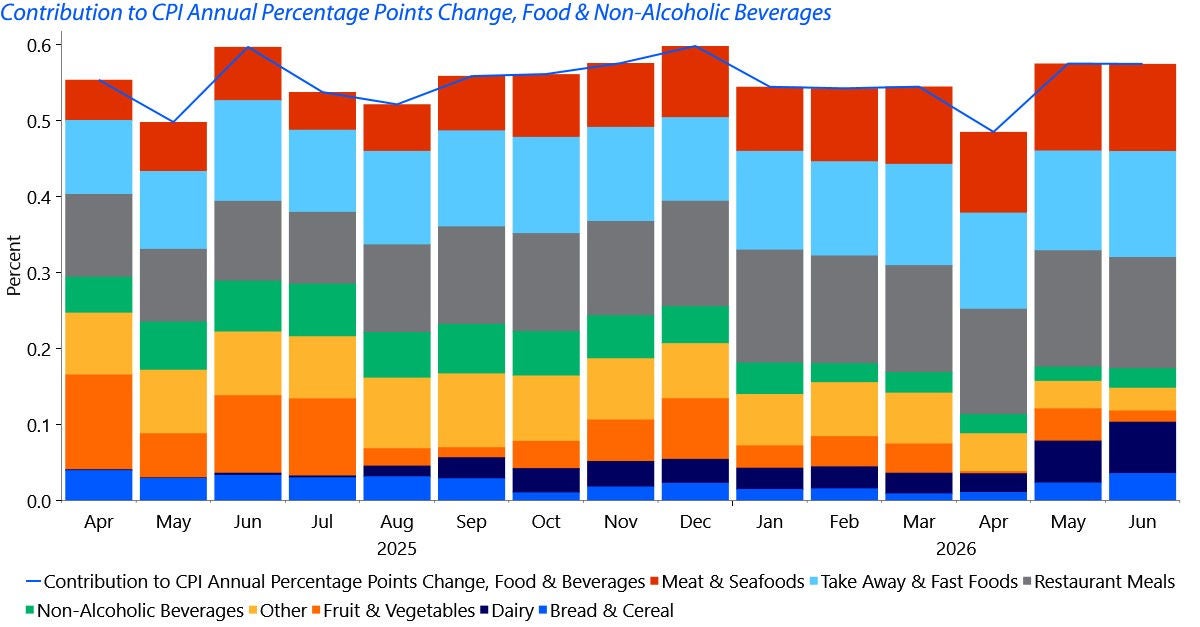
Source: Macrobond, RaboResearch 2026
RaboResearch Disclaimer: Please refer to Australian RaboResearch disclaimer here
Rabobank Australia & New Zealand Group is a part of the international Rabobank Group, the world’s leading specialist in food and agribusiness banking. Rabobank has more than 125 years’ experience providing customised banking and finance solutions to businesses involved in all aspects of food and agribusiness. Rabobank is structured as a cooperative and operates in 35 countries, servicing the needs of more than nine million clients worldwide through a network of more than 1000 offices and branches. Rabobank Australia & New Zealand Group is one of Australasia’s leading agricultural lenders and a significant provider of business and corporate banking and financial services to the region’s food and agribusiness sector. The bank has 87 branches throughout Australia and New Zealand.
Media Contacts:
Denise Shaw
Head of Media Relations
Rabobank Australia & New Zealand
Phone: 02 8115 2744 or 0439 603 525
Email: denise.shaw@rabobank.com
Will Banks
Media Relations Manager
Rabobank Australia
Phone: 0418 216 103
Email: will.banks@rabobank.com