
28/10/2026
Australia's food inflation problem hasn't disappeared, but it has changed character, according to RaboResearch senior food analyst Michael Harvey.
“Rather than broad-based inflation across the supermarket basket, we're now seeing much greater divergence between categories,” he said.
The latest (September 2026) Consumer Price Index data, released by the Australian Bureau of Statistics today, showed Australia's overall headline rose 4.3% in the 12 months to September 2026, accelerating from 4.0% in August.

Rabobank senior consumer foods analyst Michael Harvey.
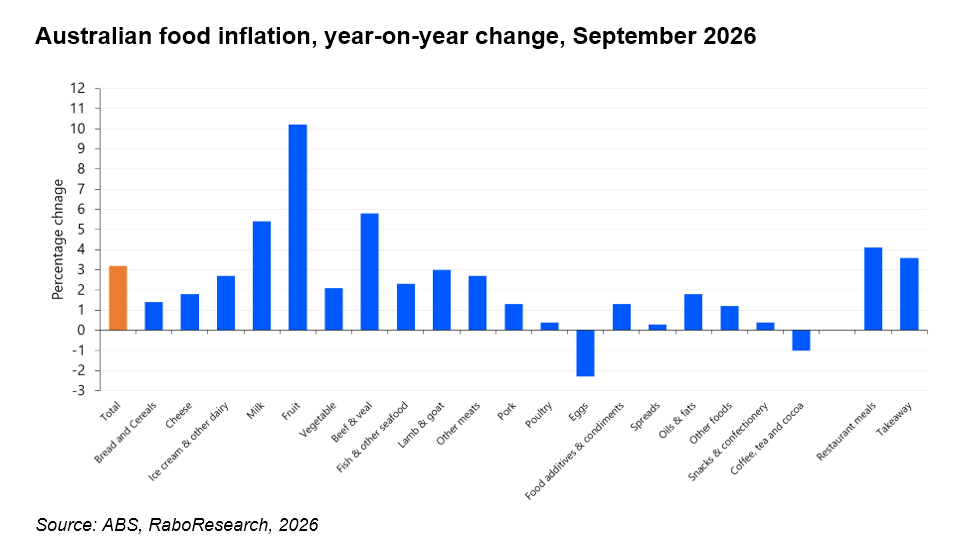
“Inside the food basket”, Mr Harvey said, inflation remains below the headline rate but has edged higher. Food and non-alcoholic beverage prices rose 3.2% year-on-year to September, up from 3.0% to August. Beneath that headline number, however, price movements vary considerably across categories,” he said.
“Animal proteins are a good example. Beef remains an inflation hotspot, although price growth has slowed considerably from its peak earlier this year,” Mr Harvey said. “Beef and veal prices were 5.8% higher year-on-year in September, down from a peak of 13.5% in February. By contrast, pork prices fell 1.3% year-on-year, marking a second consecutive month of price deflation, while poultry inflation was subdued at just 0.4%.”
That widening price gap between protein categories matters for consumers, Mr Harvey said. “As household budgets remain under pressure, relative price differences provide a stronger incentive for shoppers to substitute between proteins and seek better value,” he said.
Dairy inflation is shown to be running slightly above overall food inflation, Mr Harvey said. Dairy and related product prices increased 3.5% year-on-year, led by liquid milk at 5.4%, while cheese price inflation was considerably softer at 1.8%. The “softer” cheese result is consistent with more subdued conditions in global cheese markets, he said.
Fresh food was another source of price pressure in the latest data, with fruit prices rising 10.2% year-on-year to September. “Fruit prices are inherently volatile and particularly sensitive to seasonal availability and changing supply conditions,” Mr Harvey said.
There had also been a material easing in parts of the non-alcoholic beverage category, Mr Harvey said, with coffee, tea and cocoa prices declining 1.0% year-on-year in September, in contrast to stronger inflation elsewhere in the beverage aisle.
Mr Harvey said “foodservice inflation remains relatively sticky”. “Meals out and takeaway food prices were 3.9% higher year-on-year, including restaurant meal inflation of 4.1%. Foodservice businesses continue to contend with a broad cost base spanning labour, occupancy, energy and ingredients,” he said.
Mr Harvey said there are “encouraging signs emerging from global commodity markets, but consumers and the food industry are not completely out of the woods”. Weather risks, energy prices and geopolitical uncertainty remain important variables heading into 2027.
“Back home”, he said, “the inflation backdrop is colliding with weak household sentiment and a highly value-conscious consumer”.
“ANZ-Roy Morgan Consumer Confidence stood at 67.9 in late October, down 17.9 points from a year ago,” Mr Harvey said.
“The latest trading update from Woolworths provides a useful window into how these pressures are influencing grocery purchasing. Australian Food comparable sales increased 6.1%, supported by strong volume growth, while average prices declined 0.7%. Own and exclusive brands grew 8.5%, supported by strong performance across fresh produce and meat.”
Mr Harvey said “the picture is of a consumer preserving grocery volumes while remaining intensely focused on value”.
“Grocery spending continues to prove resilient, but price investment, private label and promotional value are becoming increasingly important in determining where that spending goes,” he said.
RaboResearch Disclaimer: Please refer to Australian RaboResearch disclaimer here
Rabobank Australia & New Zealand Group is a part of the international Rabobank Group, the world’s leading specialist in food and agribusiness banking. Rabobank has more than 125 years’ experience providing customised banking and finance solutions to businesses involved in all aspects of food and agribusiness. Rabobank is structured as a cooperative and operates in 35 countries, servicing the needs of more than nine million clients worldwide through a network of more than 1000 offices and branches. Rabobank Australia & New Zealand Group is one of Australasia’s leading agricultural lenders and a significant provider of business and corporate banking and financial services to the region’s food and agribusiness sector. The bank has 87 branches throughout Australia and New Zealand.
Media Contacts:
Denise Shaw
Head of Media Relations
Rabobank Australia & New Zealand
Phone: 02 8115 2744 or 0439 603 525
Email: denise.shaw@rabobank.com
Will Banks
Media Relations Manager
Rabobank Australia
Phone: 0418 216 103
Email: will.banks@rabobank.com