
Posted by on
18/11/2026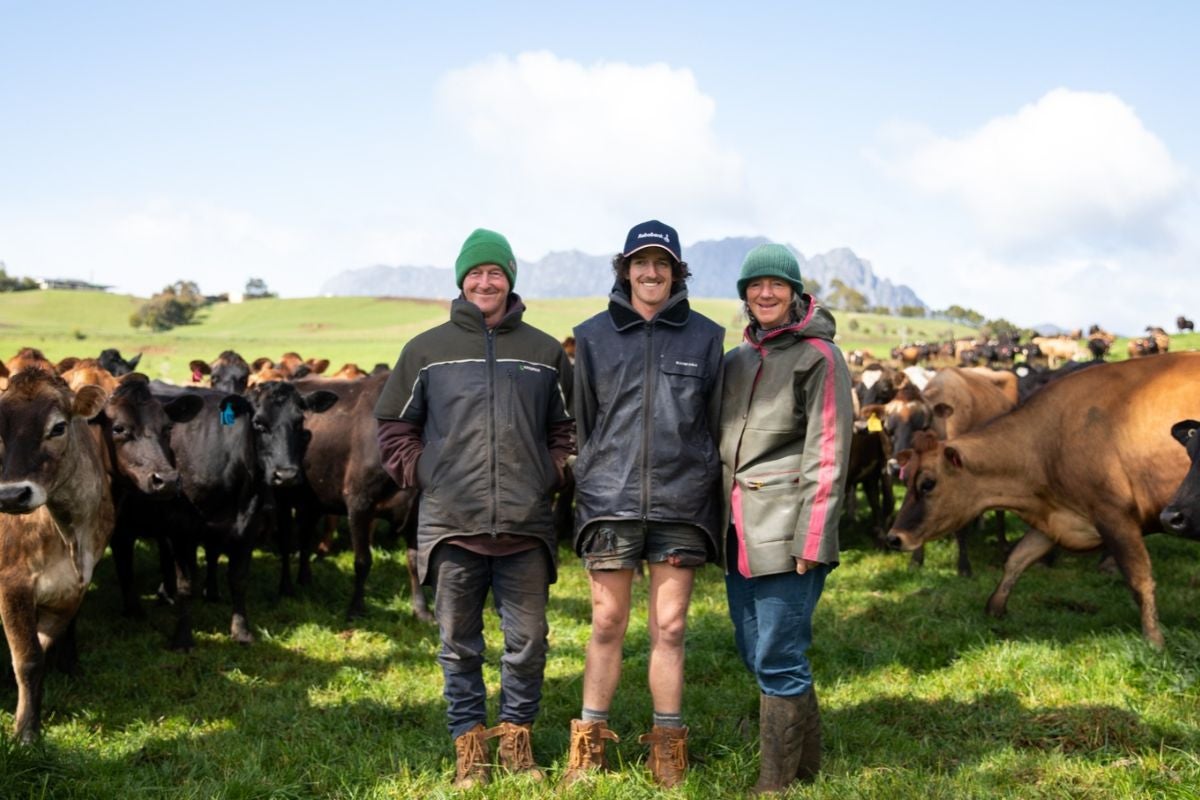
Sheffield’s Richard Smart and Trina Hole, with son Archie Smart, centre.
Frustrated by a lack of farming opportunity in their native England, Richard Smart and Trina Hole took a dramatic leap of faith – landing on the other side of the world in one of Australia’s outermost States.
Richard and Trina knew little of Tasmania until reading an article on the region, before promptly phoning the story’s author to pick his brain about the local dairy industry.
“We were renting a farm in Somerset,” Richard explains. “It was a 33-hectare dairy farm without a dairy – which we built. A couple of years later we opened a farm shop and had 600 laying hens, yet as we were only farm tenants the banks wouldn’t back us to buy land.”
Rented County Council Farms were commonplace as starter farms in the region, yet it was a structure that hobbled Richard and Trina’s business vision – with agriculture a long-held passion.
“At 12, I was given six meat chickens to raise for Christmas,” Richard smiles. “This soon evolved into raising fresh turkeys and chickens – I’d pluck and dress 1,000 birds for Christmas every year, and I milked 100 cows, so I’ve never lacked work ethic or a business plan, but in Somerset we felt hamstrung renting.”
So inspired by the article on Tasmania, the couple was no sooner on a flight to visit the region in person.
And with their return to the UK coinciding with Foot in Mouth disease, and a local crime wave resulting in their farm shop ransacked and 300 large square bales of hay set alight, Tasmania had never seemed so appealing.
“We’d found a local real estate agent and farm consultant and of course our first question was ‘where do we get money from’, and they pointed us in the direction of Rabobank,” Richard reflects.
“In the UK, we found bank managers quite snooty, they came with a suit and tie and briefcase and the response we got was always the same - “no money this year, but try again next year.”
“In Australia it was the complete opposite, we spoke with a rural manager who was excited by our vision.”
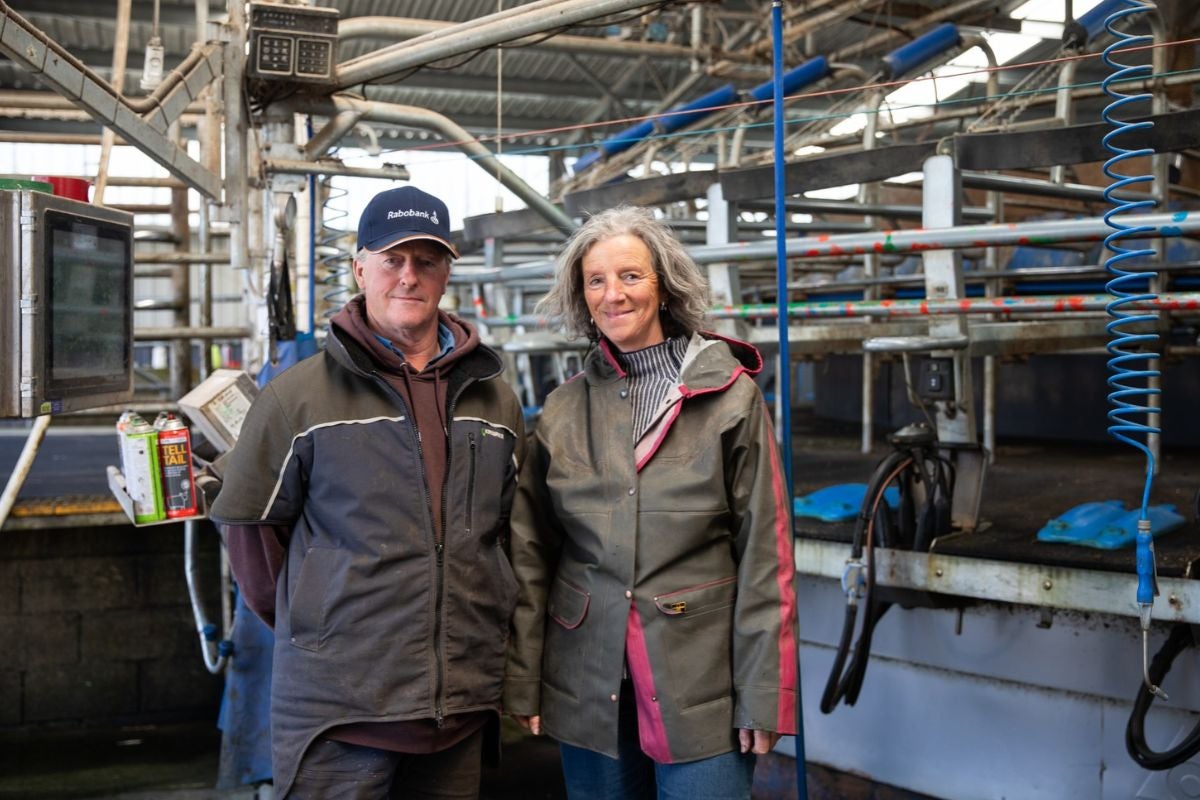
Richard and Trina have grown a thriving Tasmanian dairy business through hard work and vision.
Yet, the reality of their Sheffield property, a 67ha dryland dairy farm with an aged 40-unit rotary, soon hit home.
“It was like something out of a movie – when they talk about ‘renovators delight’, this was the extreme, it required far more than a little reno, there were fences down, the dairy was filthy, the rotary dairy barely moved, we had a lot of work ahead of us,” Richard grimaces.
Their family dog, tractor and furniture eventually arrived from the UK, buoying their resolve, and it was at the Australian Dairy Conference in Devonport, where their Rabobank manager was so optimistic in the potential of dairy in the region, that they were encouraged to buy more land.
“We’d spent ten years in the UK trying to expand our business with no headway, and here we were in Australia suddenly with so much opportunity.”
The couple purchased another four blocks from neighbours within their first nine years, and another block in the Barrington region three years ago, together with their son, Archie, who independently runs his own a beef, poppy, and potato enterprise.
The business has grown substantially, with Richard and Trina currently milking up to 500 cows, and production targeted at more than 250,000 kg/MS annually.
Over time, the couple has also increased the milking platform to approximately 160ha, and invested significantly into the development of 60ha of irrigation, construction of a new 50-unit rotary dairy, a calving shed, and infrastructure to support both family and farm employees.
“When we arrived, the dairy was worn out – although we kept it going for 17 years! Pretty soon we were worn out too, so it was a case of we either give up, or we get better,” Richard says.
With a focus on producing a top-quality product, the couple are conscious that attention to detail and good staffing help underpin a consistent milk offering – with their milk being sold to Cadbury.
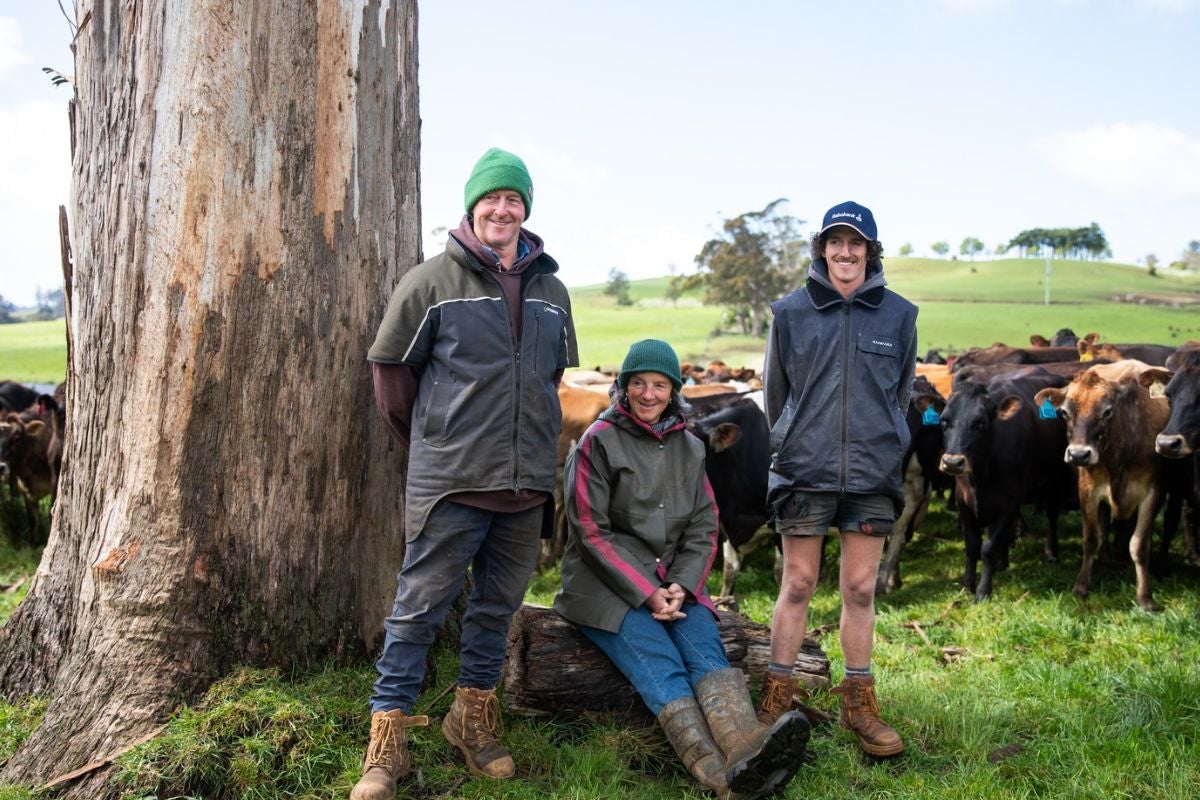
Richard, Trina and Archie on their picturesque Tasmanian property.
“We work as a team, and if everything is in top grade then no one has to work harder than they already do, we get it right first time so there are no breakdowns, no hygiene issues – the standard we set is the standard we expect, and it’s the standard our staff meet,” Trina says.
“We’re producing food, a perishable product, so we need to ensure we have standards akin to a café or restaurant.”
Richard and Trina are also impassioned teaching local youth about the dairy industry, and have employed a number of local year nine, ten and 11 students in their sheds over the years.
“We really enjoy giving young ones opportunity, they have wants and ambitions and not all students want to work in hospitality or retail,” Trina says. “Of all the youth we’ve employed over the years, most are still in agriculture, which is so encouraging.”
Rabobank underpins business growth
In refreshing contrast to their UK bank managers, Richard and Trina have welcomed their rural manager, Leigh Barker, into their business with open arms.
“There are several ways of looking at bankers, accountants, solicitors etc,” Trina explains. “They are an integral part of our business that some people may consider expensive, however realistically we can’t operate without them – and in the scheme of things they are cheap and provide good value for money.”
“I consider Leigh almost a part-time employee, he has ‘ownership’ because he wants our business to succeed, and we genuinely feel that. His is a relationship we really value.”
The couple also believe it would never have been in a position to grow the business if not for Rabobank’s All in One Account.
“The fact that we can pay interest only has been incredibly valuable, in the UK our capital debt repayments per month would have been impossible to pay – it’s so hard when you’re young and don’t have a mature business,.”
“We were able to grow from 67ha to 263ha, without capital pressure - the AIO made this business growth possible and it's been crucial to our success.”
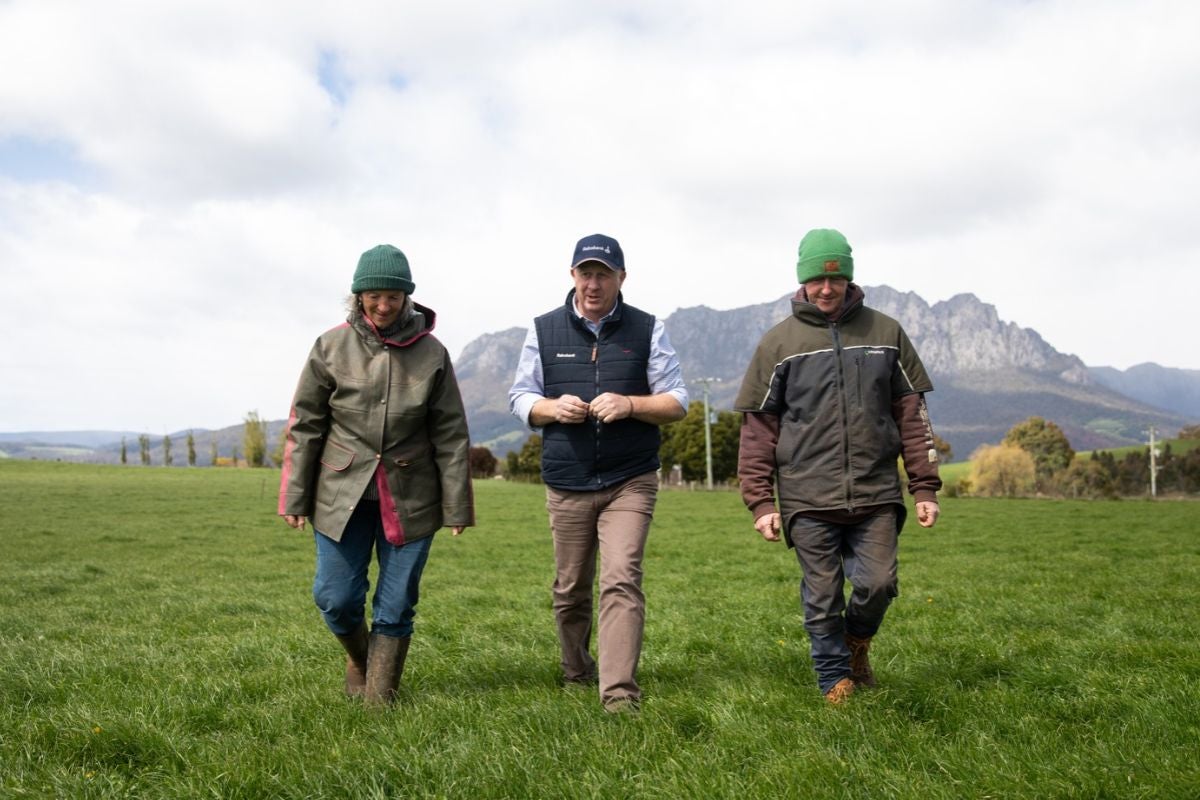
Trina and Richard with their Rabobank manager, Leigh Barker, centre.
They also farm another 80ha of leased land for further scale.
Richard and Trina reflect that it would have been impossible to have achieved all they have if back in the UK, and are quietly proud of the business that they’ve built.
“I always wanted a good farm – a tidy dairy, efficient machinery and a productive operating system, and while it’s taken a long time, I’m still not finished yet so it’s lucky I like a project,” Richard chuckles.
Trina adds that their success has been because, other than family, they had nothing to go back to the UK for.
“Within a year it was very obvious that our children were very comfortable here in Tassie, with space to be a bit feral and do what children should do.”
“When you have nothing to lose, you tend to go hard.”
The Next Gen grasps opportunity
While daughter Rebecca is a nurse in the region, chipping in at the dairy when she can, son Archie is forging his own agricultural pursuits in the same adventurous vein as his parents once did.
At just 25, he has already developed a successful farming operation separate to his parents, purchasing an initial 20 hectares whilst completing a building apprenticeship.
He then sold his initial block, expanding into a farm with 40 hectares and a home, whilst leasing an additional three properties.
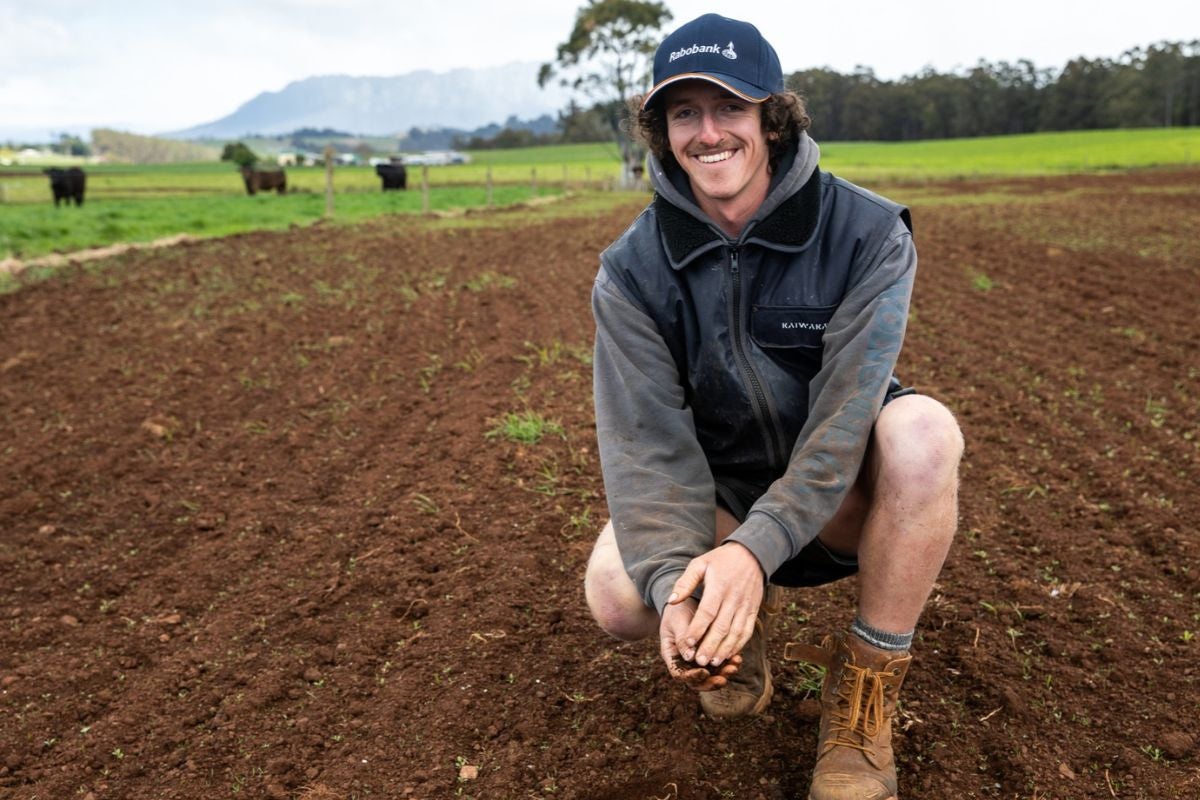
Archie Smart is wasting no time building a strong farm business.
Trading more than 300 head of cattle, whilst also growing poppies and potatoes under irrigation, Archie humbly suggests that he ‘likes trying new things’.
Yet, like his parents, he’s a self-starter who's not afraid to pick up the phone and make things happen.
He’s currently growing spuds under another grower's contract, after hearing a whisper the grower was going to focus on dairy.
“I just made the call and asked if I could have his contract, and now I’m growing four hectares of spuds for Simplot.”
Whilst he admits taking on so much debt at such a young age was daunting, the hardest part was making the initial decision.
“Once you commit and borrow the money you’re in it, and you have to make it work, and now I’m in a position where I’d like to buy more land – it’s an exciting point to reach.”
With clear growth aspirations and business vision, Archie understands the importance of personal and professional development, and has participated in RaboElevate’s Financial Skills Workshop, and Young Farmers Forum.
The workshop, supported by the Rabo Client Council, was held in Campbell Town and specifically focussed on financial skills specific to farm businesses.
“I learnt a lot about cashflow and budgets, and what the bank needs for me to successfully grow, and it really opened my eyes to the fact that I need to run the numbers more often.”
“I have big ideas, but they mean nothing if I can’t run the numbers.”
In September Archie attended the Young Farmers Forum, held this year in Ballarat – embracing the opportunity to “get off the island and meet some other like-minded young farmers”.
A three-day program which included a mix of classroom guest presenters and practical on-farm tours, Archie gained valuable insights from the opportunity.
“I really enjoyed getting on-farm and seeing how farmers have improved their businesses, and how they’ve been structured so that the farms can run without the owners necessarily there 24/7 – we all tend to think our farms will stop the minute we walk away, which doesn’t need to be the case.”
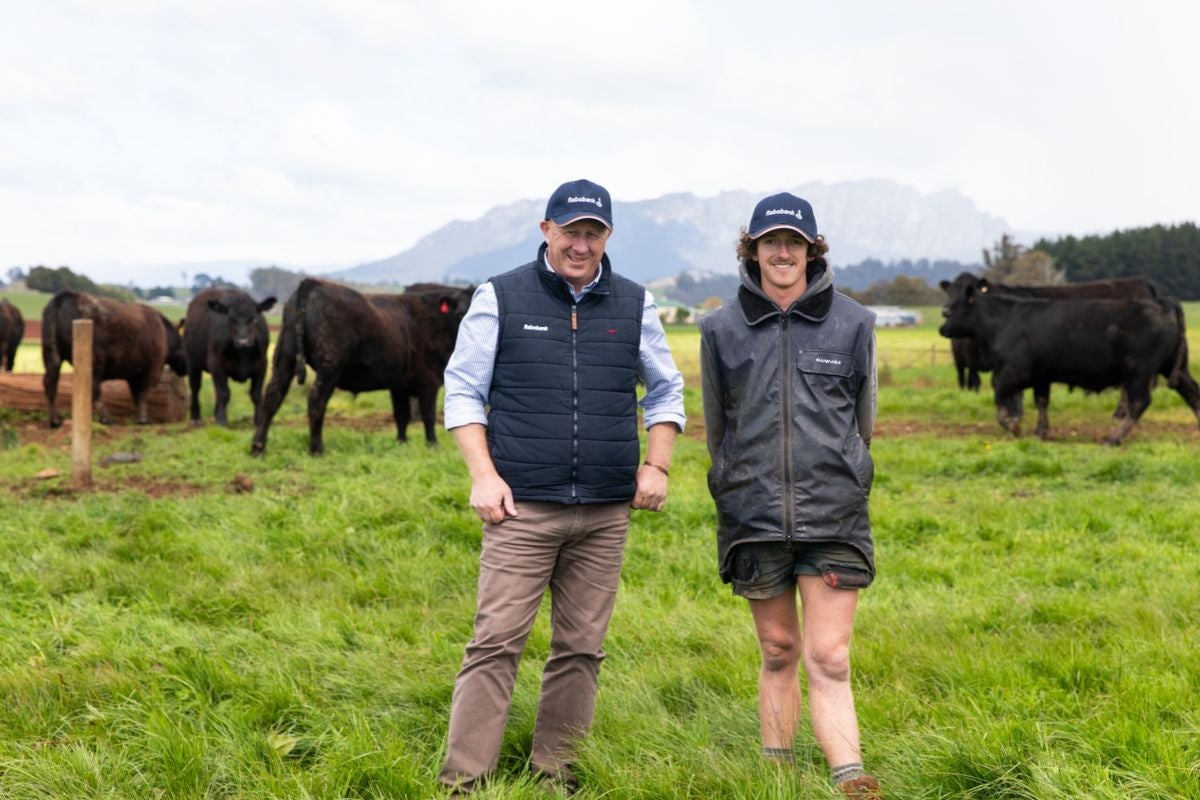
Rabobank's Leigh Barker with next-gen Tasmanian producer, Archie Smart.
Having met a number of other young Tasmanian farmers through the program, Archie is grateful to be expanding his local network, and he commends Rabobank on hosting such a worthwhile initiative.
“The Young Farmers Forum really demonstrates that Rabobank is investing in the next gen – they want young farmers to do well, and it’s incredible that a bank would organise an event like this.”
And with poultry a formative cog in his father’s agricultural journey, Archie too has a soft spot for a feathered flock.
“I’m very curious to learn more about poultry, and how I can grow and diversify my business without having to necessarily purchase more land - I really like the idea of building commercial chicken sheds.”
“It feels like a strategy that could leverage my poorer land, and I could utilise the chicken manure for nutrients, and the Young Farmers Forum really piqued my interest in this space.”
“I’ve got a few ideas brewing, and we have a local poultry operator nearby, so I’ll be prepared when they’re ready to expand and I’ll be picking that phone up again.”
While Archie is humble in his, and his family’s success, he believes his unflinching ability to make things happen is in the genes.
“I don’t think we’re necessarily gutsy, we all have a strong work ethic, and none of us seem to be able to sit still for long, so I think it’s just in our blood to have a go.”