
Posted by on
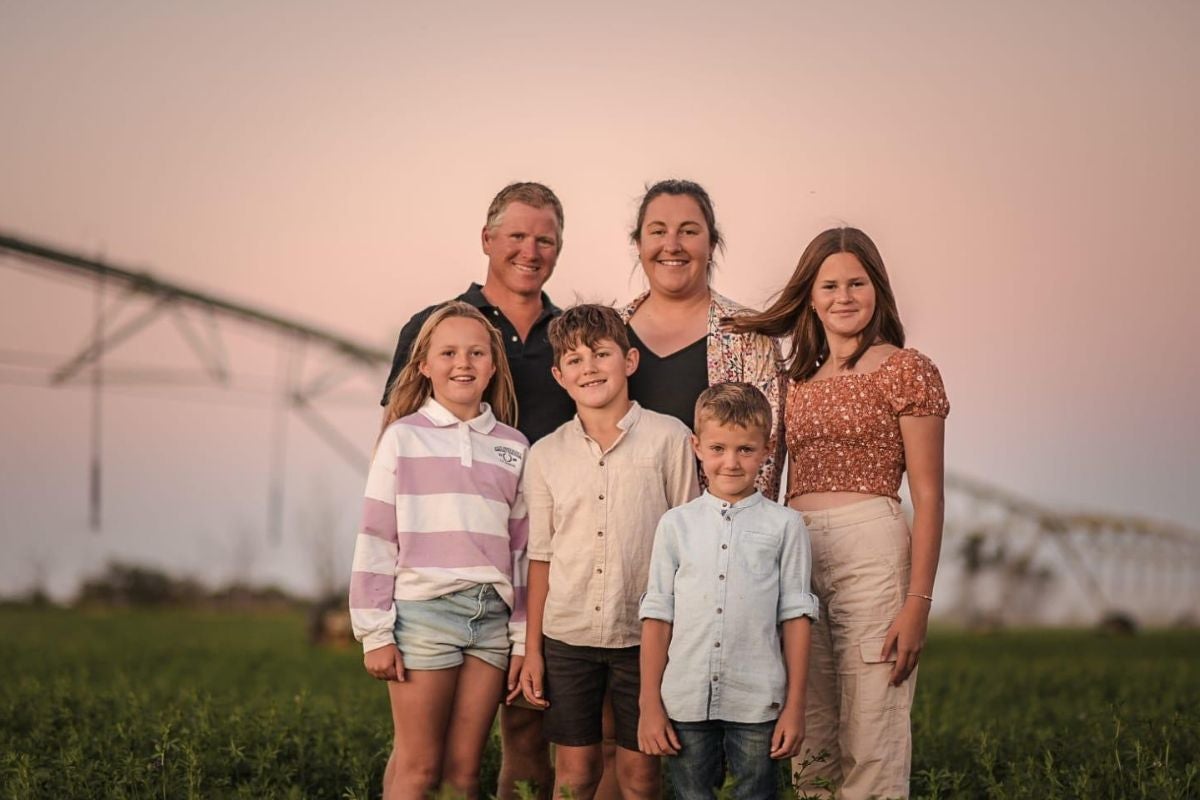
Scott and Anna Fitzerald with children Isla, Hamish, Will and Amelia.
Scott and Anna Fitzgerald exemplify the dairy industry’s remarkable shift in mindset, with technology and innovation affording their young family a refreshing balance of production and lifestyle.
So much so, in fact, that the family, including their four children, Amelia, now 16, Isla, 14, Hamish, 12 and William, 10, enjoyed in a six-month sabbatical travelling Australia by van – an opportunity unheard of in traditional dairying.
Scott, second-generation on his family’s Tongala dairy in northern Victoria, had little intention of returning to the industry, having seen first-hand how the intensity of dairy could “dictate your life”.
However, by his mid-20s and armed with a trade, he’d gained a new appreciation for the farm, and the type of life he and Anna aspired for their own children.
“I came home and was working with dad, yet we still couldn’t both attend family weddings or events, it was one or the other, and my mindset was that I was not going to let the farm be so restrictive,” he explains.
“We could see the potential of technology on modern dairy farming, and knew our pathway – we also realised it was going to be a hard slog to get there!”
In 2013, Scott and Anna took over the enterprise, leasing the property through a long-term arrangement rather than purchasing it, upon his father’s advice.
“Leasing freed up capital, enabling us to invest in infrastructure and efficiencies to grow the business. We leased to purchase the 250 cows we were milking, and our priority was to grow the business”
Rapid growth pays dividends
Two opportunistic property purchases in addition to a dairy rebuild – all in the midst of a poor season – kept the couple on their toes, yet the enterprising and capable duo mitigated costs by repurposing a second-hand platform.
“Our old 20-unit swing-over dairy was worn, everything was manual, there was no individual feeding system so cows weren’t fed accurately, and we had to physically look at the cow to identify her – we couldn’t push any boundaries, and it was the bottleneck in our business,” Scott reflects.
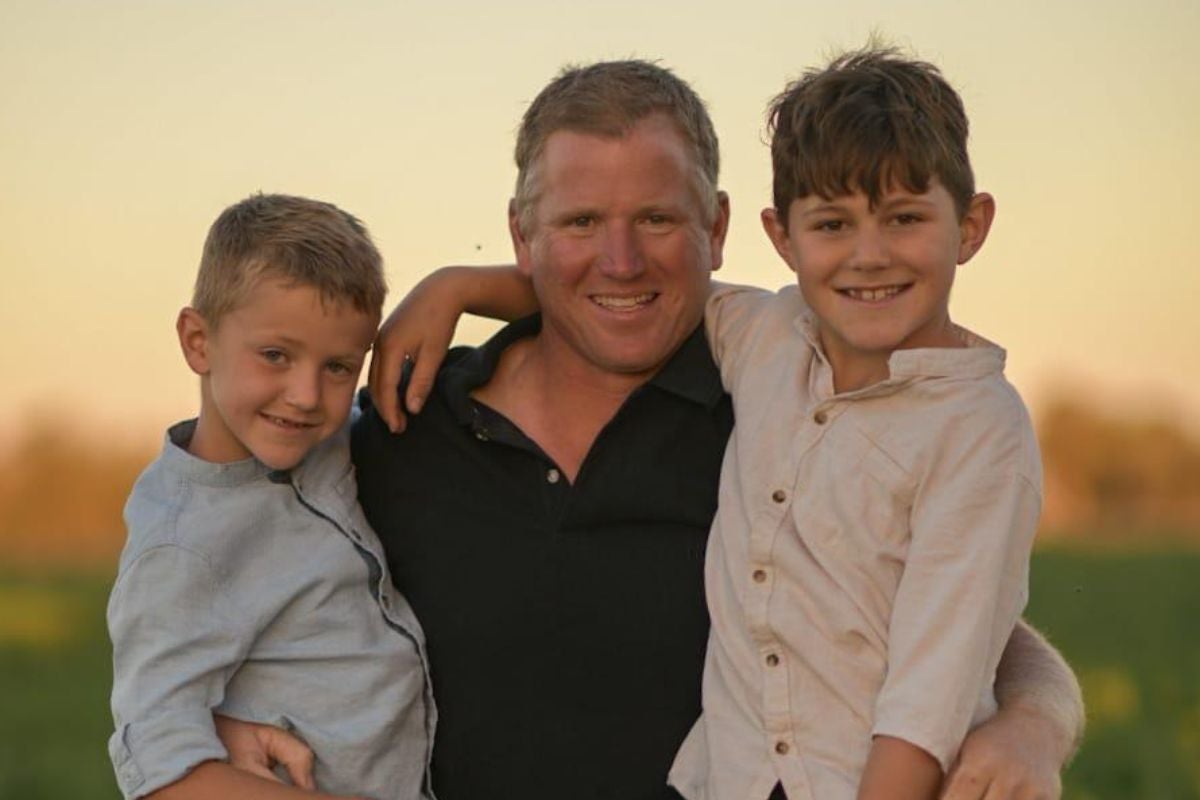
Scott Fitzerald with sons, Will and Hamish.
“We found a 50-unit rotary dairy with cow identification capability that had done very little work – it was modern, big and had the tech we needed to inevitably grow our herd.”
Leveraging his refrigeration trade skills, Scott transported, helped build, and project manage; and the development came in at half the price of a new build.
“So many people told us we were mad, it was a terrible time seasonally to invest so heavily, but now we’re just so glad we did it – costs have only gone up so you’d probably add another million to the figure today.”
The couple also wasted no time improving their additional blocks, and purchasing a third – their one holding now stands where many smaller farms, each with their own infrastructure, previously existed.
“We’ve upgraded laneways, fencing, water points, installed a pivot and a modern irrigation system so we can really capitalise on gaining economies of scale,” Scott explains.
“Initially, it was a struggle to secure the funding for these works with our previous bank, yet the efficiencies gained from each development has improved our profits and business strength, and we’re at a point now that gaining finance is no longer something we have to worry about, which is a relief.”
The business’s new irrigation capabilities now underpins a longer-term production system, with Scott explaining that they no longer operate season by season.
“In the past we’d get to springtime and be out of stored feed, so we’d anxiously wait for the spring flush, whereas now we’re growing and cutting fodder year round, our pivot runs throughout summer, and we’re forward planning two years down the road.”
Maize and Lucerne are also new additions into their rotation, high value irrigated crops boosting business diversity, and strength.
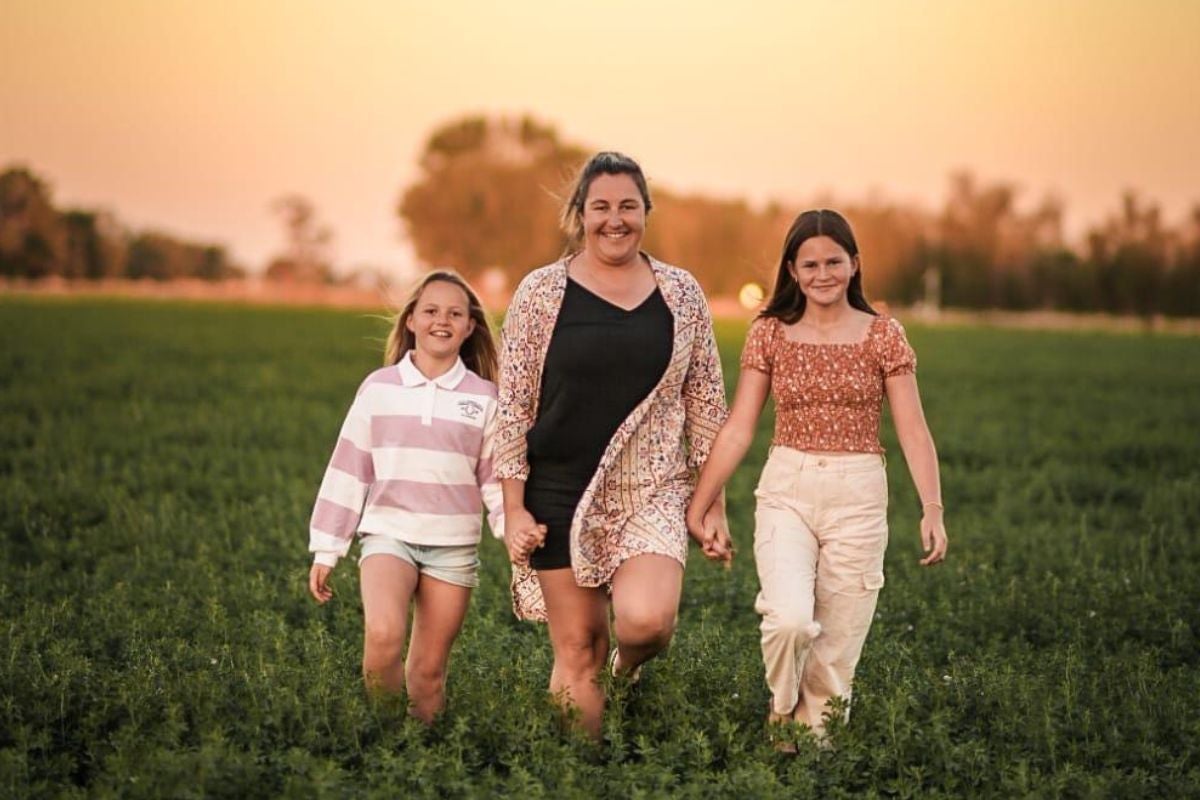
Anna Fitzgerald with daughters, Isla and Amelia.
Running predominantly Holstein Friesian cows, the Fitzgeralds are one of only 26 dairies supplying A2 milk – milk that contains exclusively the A2 protein, and lacks the A1 protein found in regular commercial milk.
“It’s really great being part of this community,” Scott smiles, “We supply our milk to Kyvalley Dairy in Kyabram, and we’re really proud to be part of such a collaborative and transparent group of farmers.”
Another significant change the couple has implemented is adjusting their system to all autumn calving – a considerable feat, and one the whole family now benefits from.
“We were up to 500 cows with spring and autumn calving, yet when we really looked at the budgets closely we realised we’d be more efficient with just one calving,” Anna explains.
With the decision validated by Covid staffing issues, and the season, the couple reduced their herd to 300, selling their spring herd to simplify and streamline the operation.
Building lifestyle into a dairy business
This simplification also proved catalyst for the couple taking six months off-farm travelling Australia with their young family.
“We spent a year leading up to the trip working with our four staff to make sure it was realistic, and our staff were integral to the decision – as was Starlink!”
“We calved cows down in March, rejoined them in June, and returned home in December ready for them to calve down again, and the business continued as normal without us.”
For Scott and Anna, the trip was the culmination of their vision for the operation.
“It was the best thing we’ve done for our family, the kids were a great age, and we’d built the business so it didn’t rely on us day-to-day, although stepping away for six months was something that exceeded even our own expectations,” Anna smiles.
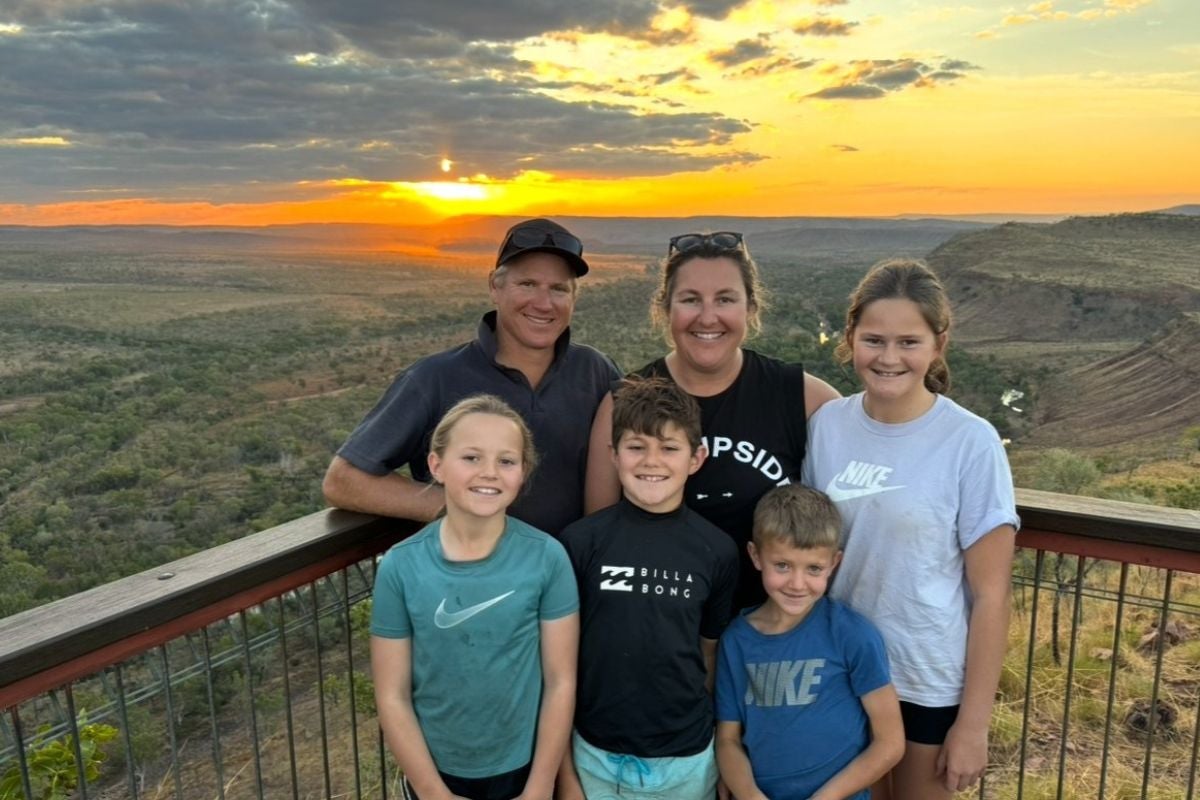
The family during their adventure around Australia.
While the family now reaps the lifestyle spoils of their modern dairy operation, the toil of those first ten years is never far from mind.
“It was a very hard slog,” Scott concedes. “If it was still that hard today I don’t think I’d have the passion that I do, but we knew things had to change, and we made some pretty gutsy moves that have thankfully paid off.”
The couple is now gradually purchasing the home block from Scott’s father, and last year added another young stock and fodder property to their operation.
However, Scott is mindful not to put too much additional pressure on the business.
“We’re at a bit of a precipice now, we’ve created so much drive and motivation to grow, but we need to be careful that it doesn’t blow out and we’re back to square one working every weekend – at the moment we’re at that happy medium with our staff, and our risk appetite.”
Gaining insights on the Rabo New Zealand Dairy Knowledge Tour
This week, Scott and Anna will again step off farm, this time for Rabobank’s Dairy Knowledge Tour across New Zealand.
Having previously participated in – and been impressed by – RaboElevate’s Agri Executive Development Program (EDP) in the past, Scott is always curious to engage in Rabobank’s suite of knowledge-sharing and networking opportunities.
A former Chair of the Australian Dairy Conference Programming Committee, Scott smiles that he was ‘too green’ for the role, and leveraged the EDP for personal development.
“It was really valuable in gaining skills like public speaking required for industry roles, and learning about yourself, and the way you communicate and align with staff was terrific, my ability to manage staff improved dramatically after completing the Rabo EDP.”
One of the greatest benefits of the EDP was networking with other farmers from across Australia and New Zealand, which was a major drawcard when signing on for the upcoming dairy tour.
“To travel to New Zealand with like-minded dairy farmers, and knowing the calibre of these farmers is exceptional, is really exciting.”
Having been on numerous farm tours during his role with the ADC, through his local dairy group, as well as a European Dairy Farmers Congress Tour in Spain, Scott and Anna understand the value of Rabobank’s knowledge tours.
“If you’re to visit these farms by yourself, it’s good, but when you visit with a group of other farmers you get a much deeper experience thanks to the conversations it provokes,” Scott says.
“With any of these tours, it’s not about trying to replicate, it’s about gaining insights to make your farm better, and managing those one-percenters.”
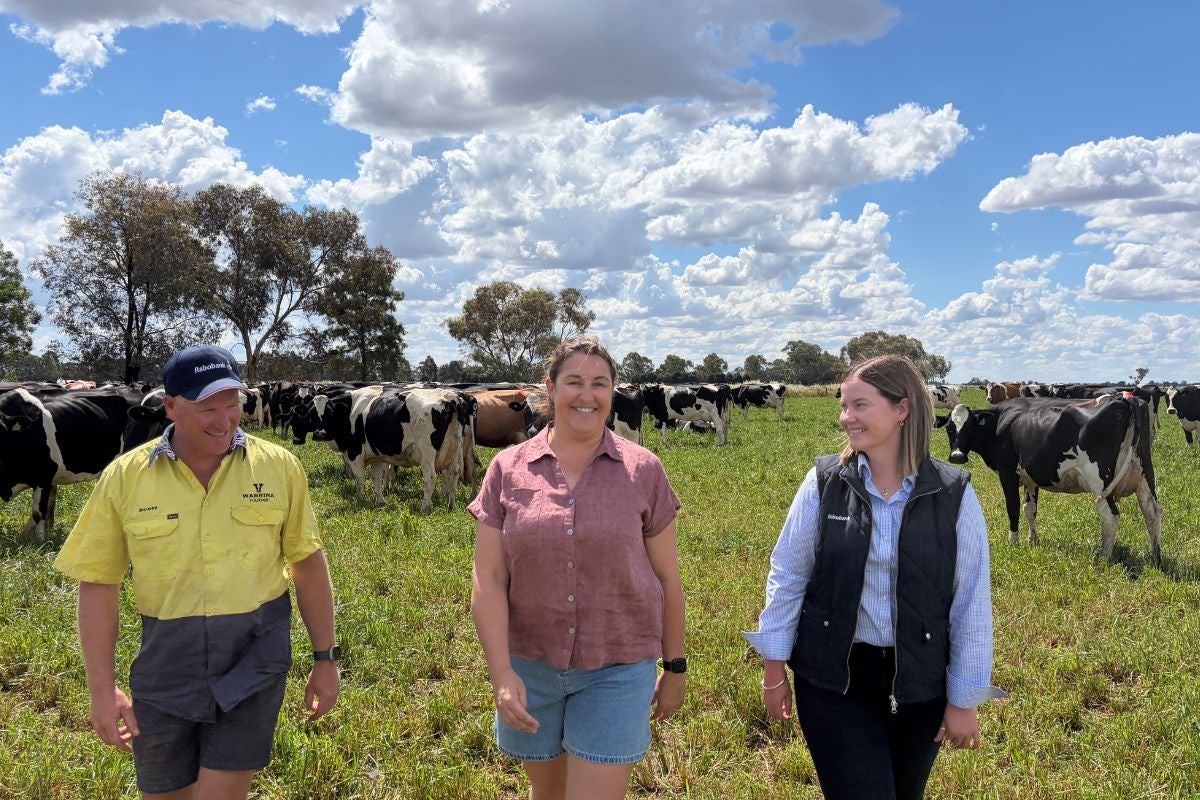
Scott, Anna, and their Rabobank Rural Manager, Kate Hemphill.
Having come off the back of a wet season in Victoria, the couple is curious to see how New Zealand dairy farmers manage in high rainfall regions.
“Higher stocking rates in the wet weather has been a challenge this season. Ours is a pasture-based system with a mixer wagon, and the more cows we have, the further we have to walk them to get to grass – yet walking them five kilometres a day in soggy conditions doesn’t work, so we’re looking at how we can continue to grow our herd numbers in light of potential wet seasons.”
A relationship through the seasons
For the Fitzgeralds, a strong banking relationship has played an important role in the growth of their business.
"Kate Hemphill's work ethic and willingness to work alongside us to achieve our goals has been exceptional, and she's been a key part of our growth journey," Anna says.
"Agriculture is a long-term game, and having a relationship built on trust and understanding makes a real difference. The team knows our story, what we're trying to achieve and the challenges we face, which gives us confidence when opportunities arise."
Anna also credits proactive communication as a key factor in the relationship.
"Communication is phenomenal. When questions come up or decisions need to be made, we know we'll get a response and the support we need. That reliability is incredibly important when you're running a business."
And at this stage, with two of their four children keen to return to the dairy, Scott and Anna aren't in a rush to encourage them home.
"It's such a different mindset for young people today," Scott says. "For me, coming home was a decision made as an adult, yet for our kids, returning home has become such an attractive option it's hard to know whether it's their true passion, so they'll be off to gain a trade or a degree first."
"At the end of the day, the fact that young people want to come back to family farms is a testament to how far dairy has come in just one generation. It's exciting to be part of an industry with so much progression and continued potential," Scott smiles.