
Rabobank brings you knowledge and insights with Jane Lowther of Lowther consulting.
We’ve all had those moments – reading an article, listening to a podcast, chatting with a neighbour or attending a course – where something lands and we really want to action that new learning or idea.
We explore what could get in the way of making change and how this can be overcome.
In farm business, we face plenty of challenges – weather, market fluctuations and access to labour. But sometimes the biggest barrier isn’t external. It can be us.
We’ve all had those moments – reading an article, listening to a podcast, chatting with a neighbour or attending a course – where something lands and we really want to action that new learning or idea. Or think about New Year’s resolutions, where we start off with the best of intentions and plans for the year ahead. But then the day-to-day takes over and those intentions slide away – even the things that really matter. Sound familiar?
Here we explore what could get in the way of making change and how Jane Lowther of Lowther Consulting suggests this can be overcome.
Why Change Can Be Hard
Making change is often not about willpower or trying harder. It is often hard because our beliefs – often formed early in life – can work against what we want to do.
As Jane Lowther, who works with farmers on Rabobank’s agri Executive Development Program, says:
“If we want to change, we must pay close attention to our own powerful inclinations not to change.”
This is based, she says, on two key premises:
- Our strongly held beliefs drive our behaviour and what we see as our choices.
If you want to change, you need to understand the thinking and beliefs shaping your behaviour. - This process can be challenging.
Do your beliefs, messages and fundamental thoughts still hold true? Until we see and challenge them, they will continue to drive our behaviour and we won’t realise why.
So how can we uncover what’s holding us back? Jane uses a practical tool called Immunity to Change Mapping, with her steps outlined below:
Step 1: Where Are You Now?
Start by asking: where am I in my life right now? How do I allocate time and energy across all areas of my life i.e. my business/work, family & relationships, community, health, finances, learning and growth? Is this working for me? Where do I want to be in five years?
Tip: Draw a quick pie chart where the size of the wedge represents how you spend your time and energy. Then consider how you would like this to look in five years? Which wedges need to shrink or grow?
Step 2: Set Your Goal
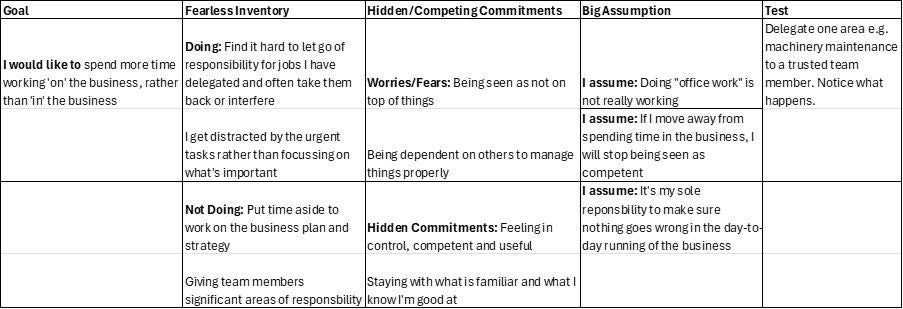
Choose an area you want to change in some way. Turn it into a concrete, behavioural goal – something you can act on, not something others need to do.
Tip: Start your behavioural goal with: “I would like to….”
Step 3: Do Your Fearless Inventory
List what you are doing, or not doing, that is working against your goal. Be specific and honest. There is no need to explain or justify in this step – just outline your behaviours.
Tip: Ask yourself: I say I want this, but what am I actually doing?
Step 4: Identify Worries and Hidden Commitments
Look at your inventory and imagine doing the opposite. What worries or concerns pop up? These feelings reveal your hidden commitments – ways you protect yourself – that undermine your goal.
Tip: Put your worries into words. Then identify your behaviours that protect you. These are your hidden or competing commitments.
Step 5: Uncover Big Assumptions
A big assumption is a belief, or set of beliefs, that feel like self-evident ‘truths’. Often, they echo voices from childhood – advice, perspectives or beliefs we haven’t consciously challenged. They may be irrational, but they often have a powerful influence on our behaviour.
Tip: Brainstorm your ‘shoulds’. Then check if your big assumptions explain your worries/fears listed earlier.
Step 6: Test Them
Then ask yourself, are my big assumptions working for me? Choose the big assumption that most gets in your way and would make the most difference, if you could change it. Then design a small, easy-to-fail test to challenge it.
Tip: What could you do or say to test the validity of your big assumption? Try something simple to see if your assumption holds true. This is where change begins.
Immunity Map – In Action
Below is an example of an Immunity Map
Final Thoughts
This process is about understanding what could drive your behaviour and then testing your assumptions to bring about change. Changing behaviour shifts our beliefs and assumptions – not the other way around.
You can also use this mapping process with your partner, family, team or organisation to help understand what assumptions you could have going on, where they come from and question, are these still valid?
At Rabobank, we’re committed to helping you and your business grow stronger with every season. This Thought Leadership series draws on the insights from our Executive Development Program, designed to equip farmers with practical tools and strategic insights to elevate their operations.
RaboElevate – your gateway to agri knowledge, skills networks and experiences to support confident decision making and guide your growth path ahead.